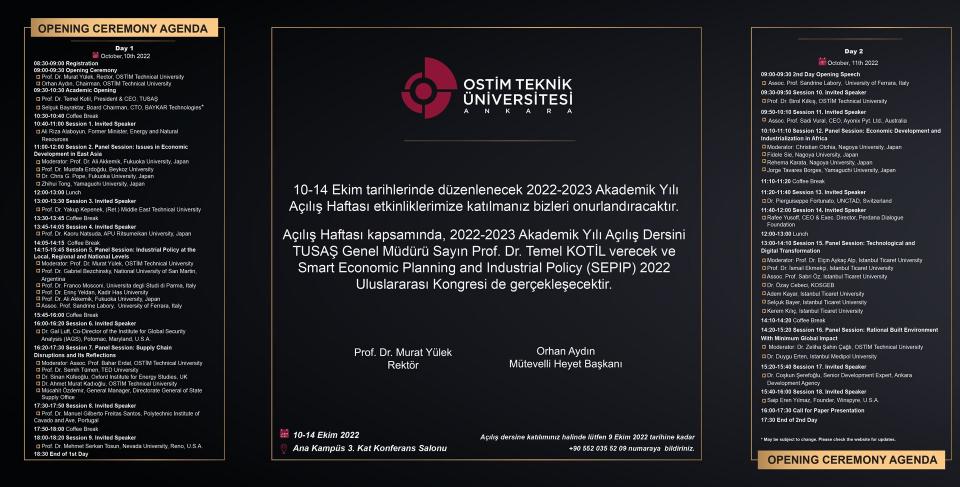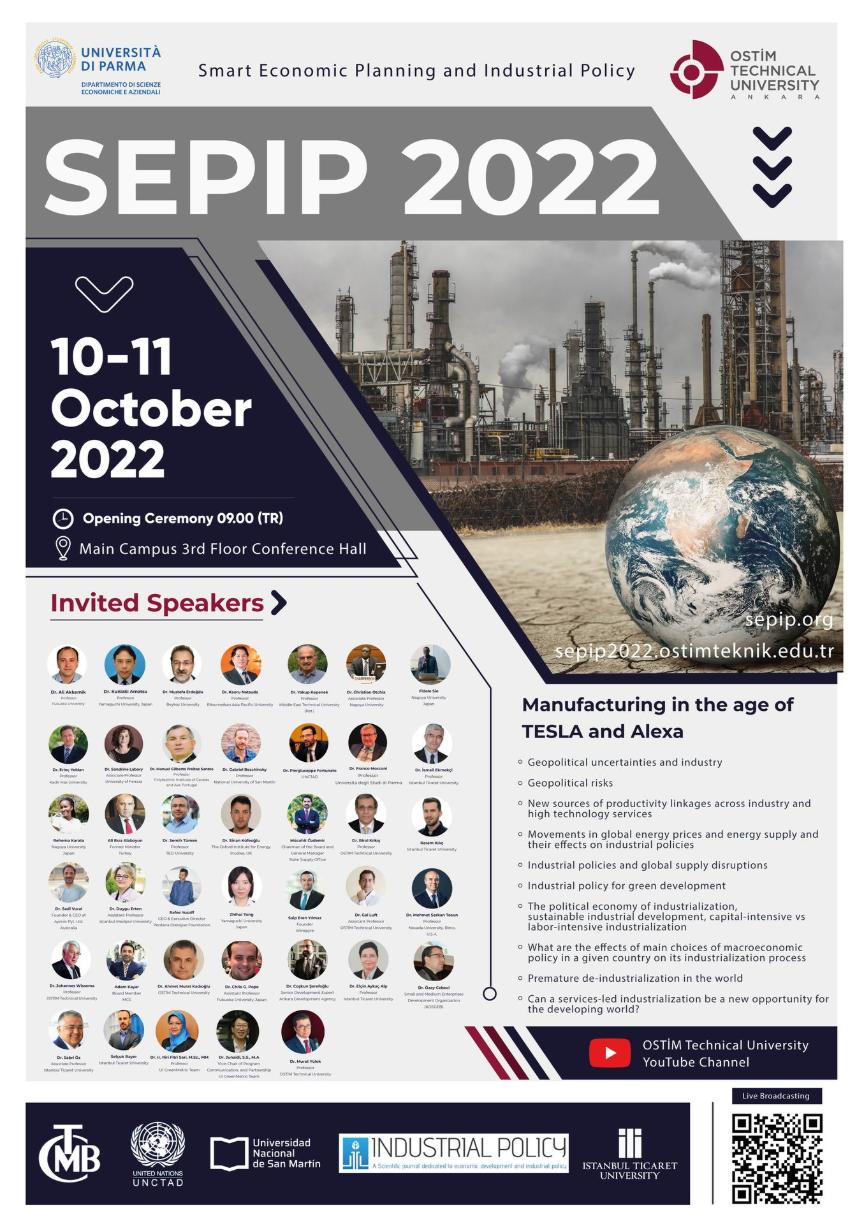
Main Theme and Sub Themes
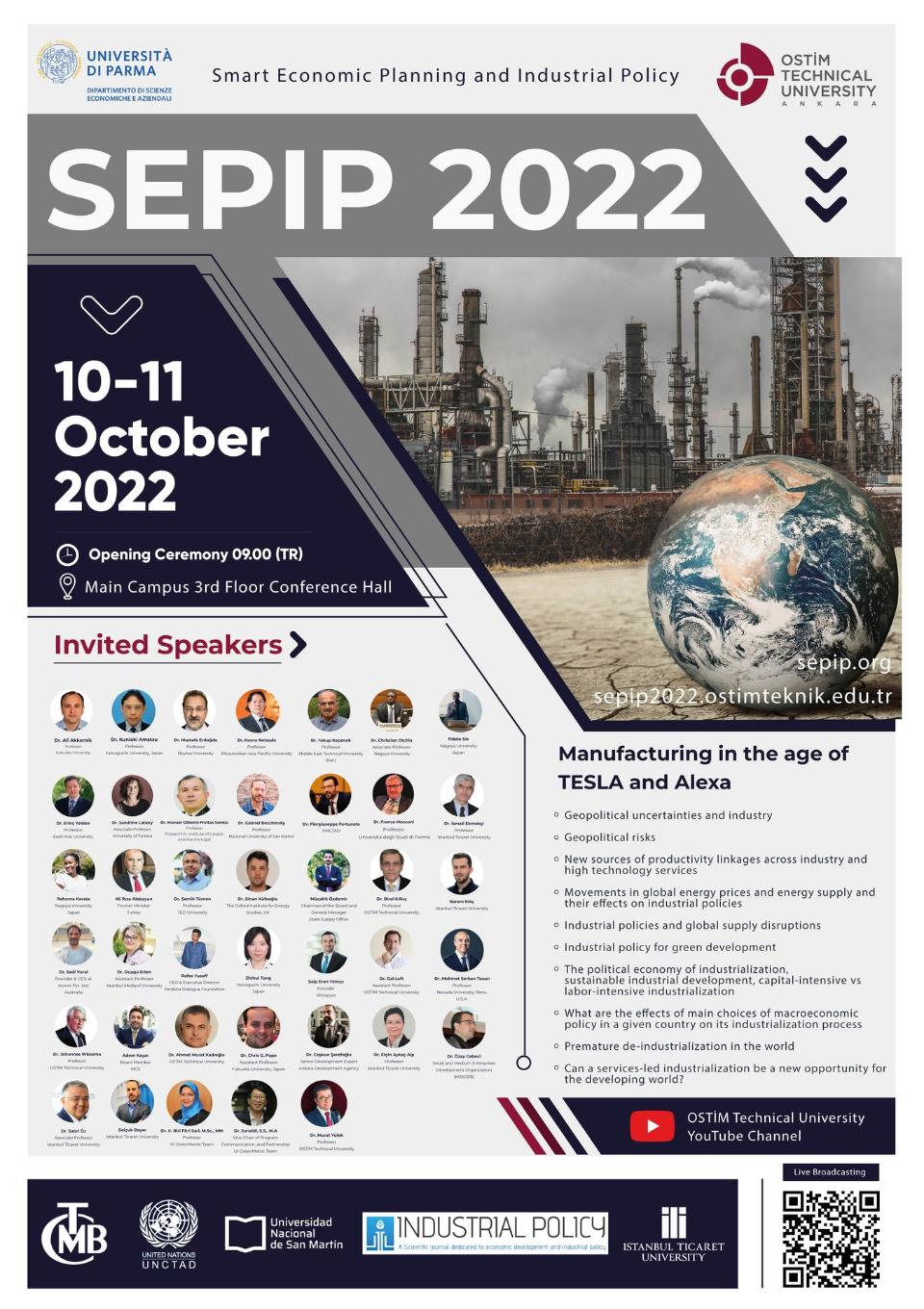
->The main theme of SEPIP 2022 is Manufacturing in the Age of TESLA and Alexa.
->Sub themes are as follows:
- Geopolitical Uncertainties and Industry
- Geopolitical risks
- New sources of productivity linkages across industry and high technology services,
- Movements in global energy prices and energy supply and their effects on industrial policies
- Industrial policies and global supply disruptions
- Industrial policy for green development
- The political economy of industrialization, sustainable industrial development, capital-intensive vs labor-intensive
- What are the effects of main choices of macroeconomic policy in a given country on its industrialization process?
- Premature de-industrialization in the world
- Can a services-led industrialization be a new opportunity for the developing world?
About
The objective of the Smart Economic Planning and Industrial Policy (SEPIP) Conference is to bring together researchers, practitioners, regulators, and policy makers from the globe with a view to share results of academic studies, exchange views, share experiences and discuss fresh ideas on industrial policy, economic planning, and related contemporary tools to support economic development and national competitiveness.
SEPIP is organized by OSTİM Technical University and it aims at developing a platform that enables participants to discuss economic development at national and regional levels and the role of industrial policy and planning; to compare early theoretical and practical motivations for national development planning with those now emerging in the globalized world economy; to present real-world experiences in industrial policy and planning by international scholars with firsthand experience; to discuss new tools and approaches to development such as physical infrastructure planning, industrial policy and cluster policy.
The first SEPIP conference, held on 4 May 2014, attracted great interest and there was a wide range of attendance with international speakers from USA and Europe to Singapore and Korea including academicians as well as policy makers and practitioners.
The main theme of SEPIP 2021 Conference was entitled "Varieties of Industrialization". The spread of agro-industrialization along with the newly agriculturizing economies (NAEs); New sources of productivity linkages across industry and high technology services; Can a services-led industrialization be a new opportunity for the developing world? Or is it a farce? Varieties of industrialization pathways across time and space; Is there a certain type of successful industrialization? Premature deindustrialization in the world; What are the relationships between varieties of industrialization and varieties of capitalism which has been a trending topic in economics literature in the last decade? What are the effects of main choices of macroeconomic policy in a given country on its industrialization process? Does the policy set of Washington Consensus contribute or not, to the industrialization process of developing countries? Or does it trigger deindustrialization? How does its imposition result after four decades of its hegemony? Translation of a country's experience of industrialization to other countries; The Political Economy of Industrialization, Sustainable Industrial Development, Capital-intensive vs labor-intensive industrialization were among the topics discussed at the conference.
Uniting the actors on a common ground in order to strengthen the cooperation between developed and developing countries, public institutions and organizations, universities, non-governmental organizations and the private sector, various prominent speakers took part on this platform and discussed the impact of the epidemic on their countries’ economies, experiences in technology, innovation, and industry.
Scientific Commitees
- Prof. Dr. Murat Yülek, OSTİM Technical University, Turkey
- Prof. Dr. Ali Akkemik, Yamaguchi University, Japan
- Prof. Dr. Aylin Ege, OSTIM Technical University, Turkey
- Prof. Dr. Betül Gür, Istanbul Commerce University, Turkey
- Prof. Dr. Demiral Akbar, OSTIM Technical University, Turkey
- Prof. Dr. Erinç Yeldan, Kadir Has University, Turkey
- Prof. Dr. Fikret Şenses, Middle East Technical University, Turkey
- Prof. Dr. Franco Mosconi, Universite degli Studi di Parma, Italy
- Prof. Dr. Gabriel Bezchinsky, UNSAM
- Prof. Dr. Guillermo Rozenwurcel, UNSAM
- Prof. Dr. Johannes Wissema, OSTIM Technical University, Turkey
- Prof. Dr. Kaoru Natsuda, APU Ritsumeikan University, Japan
- Prof. Dr. Melih Bulu, Boğaziçi University, Turkey
- Prof. Dr. Mustafa Erdoğdu, Beykoz University, Turkey
- Prof. Dr. Mustafa Polat, OSTIM Technical University, Turkey
- Prof. Dr. Sabri Tekir, OSTIM Technical University, Turkey
- Prof. Dr. Sadık Unay, Istanbul University Faculty of Economics, Turkey
- Prof. Dr. Serhan Dağtaş, OSTIM Technical University, Turkey
- Prof. Dr. Travis Taylor, Christopher Newport University, USA
- Prof. Dr. Turan Erol, Sabahattin Zaim University, Turkey
- Prof. Dr. Ünsal Sığrı, OSTIM Technical University, Turkey
- Prof. Dr. Yusuf Balcı, Istanbul Commerce University, Turkey
- Assoc. Prof. Bahar Erdal, OSTIM Technical University, Turkey
- Assoc. Prof. Nurullah Gür, Medipol University, Turkey
- Assoc. Prof. Sandrine Labory, University of Ferrara, Italy
- Dr. Begüm Şahin, OSTIM Technical University, Turkey
- Dr. Metehan Yagmur, Istanbul Technical University, Turkey
- Dr. Nathanial Lane, Monash University, Australia
- Dr. Rıza Bayrak, OSTIM Technical University, Turkey
- Dr. Sabri Öz, Istanbul Commerce University, Turkey
- Dr. Serkan Bürken, OSTIM Technical University, Turkey
- Dr. Ünay Tamgaç Tezcan, University of Economics and Technology
Advisory Commitees
- Orhan Aydın, President, OSTİM Foundation/OSTİM OIZ
- Prof. Dr. Sübidey Togan, Bilkent University, Turkey
- İlhami Pektaş, Coordinator, OSTİM ARUS
- Nurettin Özdebir, Chairman, Nuriş A.Ş
- Mirzahan Hızal, General Manager, Hızal Elektroerozyon Ltd
- Mustafa Bozkurt, Chairman, Hidromek A.Ş
- Mehmet Kaybal, Chairman, Meka Engineering
Organizing Commitees
- Egehan Özkan, Academician, Head of Organization Committee, OSTİM Technical University
- Selim Girayalp, Specialist, Deputy Head of Organization Committee, OSTİM Technical University
- Hilmi Bahadır Temur, Academician, Project Specialist, OSTİM Technical University
- Bora Öç, Academician, Project Specialist, OSTİM Technical University
- Huzeyfe Erkam Candan, Academician, Project Specialist, OSTİM Technical University
- Barış Koçaş, Project Assistant, OSTİM Technical University
- Başak Sönmez, Project Assistant, OSTİM Technical University
Important Days and Venue
DATES EXPLANATION
23 September 2022 Abstract Submission Deadline
30 September 2022 Notification of acceptance/rejection
05 October 2022 Registration Payment Deadline
07 October 2022 Final paper submission deadline
09 October 2022 Final Program
10-11 October 2022 Conference Dates
Conference Venue
OSTİM Technical University
Address: OSTİM Teknik Üniversitesi, OSTİM, 06374 Ankara
Tel : +90 312 386 10 92 : +90 312 354 39 93
- Papers submitted to the conference should be unpublished work and not submitted for presentation or publication elsewhere.
- It is possible to submit papers not only in English but also in Turkish. It is important to note however that manuscripts not written in English should contain an additional abstract in English.
- Papers should be submitted by email to sepip2022@ostimteknik.edu.tr in MS Office Word format.
- Please provide an abstract of ca. 150 to 200 words. The abstract should not contain any undefined abbreviations or unspecified references.
- Please provide 4 to 6 keywords which can be used for indexing purposes.
- Authors should submit a brief biography with the final version of their accepted paper.
Title Page
- The title page should include:
- The name(s) of the author(s)
- The title of the paper
- The affiliation(s) of the author(s), i.e. institution, (department), city, (state), country
- If address information is provided with the affiliation(s) it will also be published)
- For authors who are (temporarily) unaffiliated with an official institution, we will only present their city and country of residence, not their e-mail address unless specifically requested. However, their emails should still be provided in the title page.
- A clear indication and an active e-mail address of the corresponding author and other authors
- If available, the 16-digit ORCID of the author(s)
Body of the Article
Text Formatting
Manuscripts should be submitted in Word.
- Use 12-point Times Roman for text.
- Use italics for emphasis.
- Use the automatic page numbering function to number the pages.
- Do not use field functions.
- Use tab stops or other commands for indents, not the space bar.
- Use the table function, not spreadsheets, to make tables.
- Use the equation editor or MathType for equations.
- Save your file in docx format (Word 2007 or higher) or doc format (older Word versions).
Headings
Please use no more than three levels of displayed headings.
Abbreviations
Abbreviations should be defined at first mention and used consistently thereafter.
Footnotes
Footnotes can be used to give additional information, which may include the citation of a reference included in the reference list. They should not consist solely of a reference citation, and they should never include the bibliographic details of a reference. They should also not contain any figures or tables.
Footnotes to the text are numbered consecutively; those to tables should be indicated by superscript lower-case letters (or asterisks for significance values and other statistical data). Footnotes to the title or the authors of the article are not given reference symbols.
Always use footnotes instead of endnotes.
Acknowledgments
Acknowledgments of people, grants, funds, etc. should be placed in a separate section on the title page. The names of funding organizations should be written in full.
Reference citations
Cite references in the text by name and year in parentheses. Some examples:
- Negotiation research spans many disciplines (Samuelson 1990).
- This result was later contradicted by Romer and Heshmati (1996).
- This effect has been widely studied (Lee 1991; Hamlin and Jerruti 1974; Allison et al. 2007, 2014a, b).
Reference list
The list of references should only include works that are cited in the text and that have been published or accepted for publication. Personal communications and unpublished works should only be mentioned in the text. Do not use footnotes or endnotes as a substitute for a reference list.
Reference list entries should be alphabetized by the last names of the first author of each work. Order multi-author publications of the same first author alphabetically with respect to second, third, etc. author. Publications of exactly the same author(s) must be ordered chronologically.
- Journal article
Gamelin FX, Baquet G, Berthoin S, Thevenet D, Nourry C, Nottin S, Bosquet L (2009) Effect of high intensity intermittent training on heart rate variability in prepubescent children. Eur J Appl Physiol 105:731-738. https://doi.org/10.1007/s00421-008-0955-8
Ideally, the names of all authors should be provided, but the usage of “et al” in long author lists will also be accepted:
Smith J, Jones M Jr, Houghton L et al (1999) Future of health insurance. N Engl J Med 965:325–329
- Article by DOI
Slifka MK, Whitton JL (2000) Clinical implications of dysregulated cytokine production. J Mol Med. https://doi.org/10.1007/s001090000086
- Book
South J, Blass B (2001) The future of modern genomics. Blackwell, London
- Book chapter
Brown B, Aaron M (2001) The politics of nature. In: Smith J (ed) The rise of modern genomics, 3rd edn. Wiley, New York, pp 230-257
- Online document
Cartwright J (2007) Big stars have weather too. IOP Publishing PhysicsWeb. http://physicsweb.org/articles/news/11/6/16/1. Accessed 26 June 2007
- Dissertation
Trent JW (1975) Experimental acute renal failure. Dissertation, University of California
Always use the standard abbreviation of a journal’s name according to the ISSN List of Title Word Abbreviations, see ISSN LTWA. If you are unsure, please use the full journal title.
For authors using EndNote, Springer provides an output style that supports the formatting of in-text citations and reference list.
EndNote style (Download zip, 3 kB)
Tables
- All tables are to be numbered using Arabic numerals.
- Tables should always be cited in text in consecutive numerical order.
- For each table, please supply a table caption (title) explaining the components of the table.
- Identify any previously published material by giving the original source in the form of a reference at the end of the table caption.
- Footnotes to tables should be indicated by superscript lower-case letters (or asterisks for significance values and other statistical data) and included beneath the table body.
Fee for submission is 50€
Bank Name: Akbank T.A.Ş
Branch Name: OSTİM Sanayi Branch - Ankara / Turkey
€ IBAN No: TR83 0004 6006 0303 6000 1727 43
Call for Papers
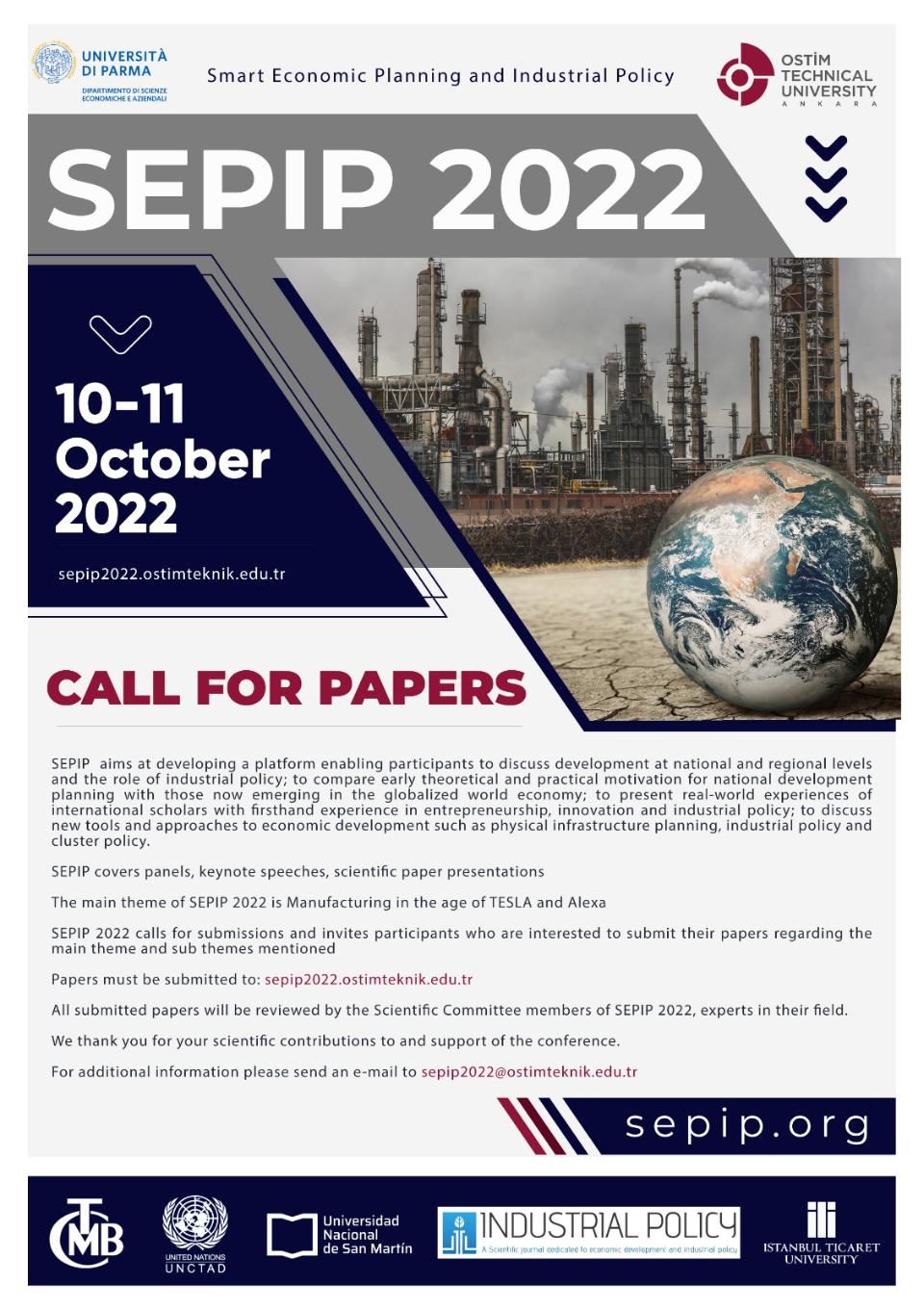
->You are invited to submit your scientific papers for SEPIP2022.
->Papers should be written in english, the official language of the event.
->Deadlines
Please, remember the following important dates:
- Abstract & work in progress papers submission deadline: 23 September, 2022. (included)
- Notification of acceptance/rejection: 30 September, 2022.
- Final paper submission deadline: 07 October, 2022 (included)
Guidelines
- Papers submitted to the conference should be unpublished work and not submitted for presentation or publication elsewhere.
- It is possible to submit papers not only in English but also in Turkish. It is important to note however that manuscripts not written in English should contain an additional abstract in English.
- Papers should be submitted by email to sepip2022@ostimteknik.edu.tr in MS Office Word format.
- Please provide an abstract of ca. 150 to 250 words. The abstract should not contain any undefined abbreviations or unspecified references.
- Please provide 4 to 6 keywords which can be used for indexing purposes.
- Authors should submit a brief biography with the final version of their accepted paper.
Egehan Özkan, Academician, Head of Organization Committee
egehan.ozkan@ostimteknik.edu.tr
Tel: 0(312) 386 10 92 Dahili: 1641
Selim Girayalp, Specialist, Deputy Head of Organization Committee
selim.girayalp@ostimteknik.edu.tr
Tel: 0(312) 386 10 92 Dahili: 1150